

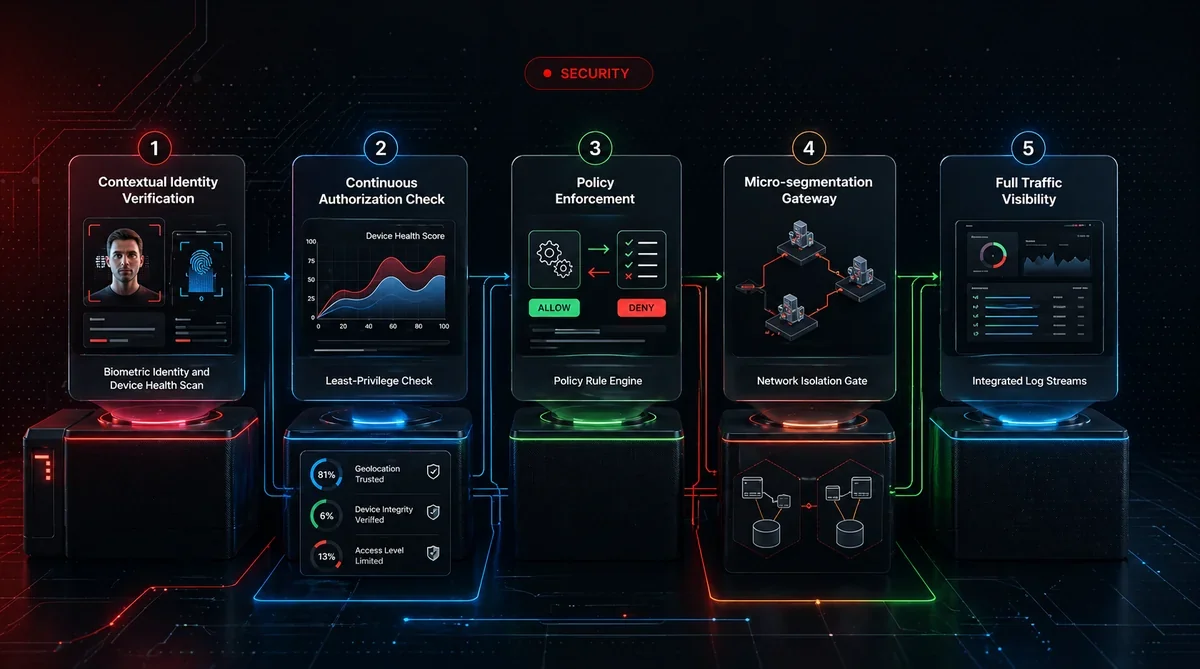
Most security programs do not fail because people disagree with zero-trust in principle. They fail because the phrase gets translated into a shopping list. A board asks for stronger security, leaders approve two or three new platforms, and six months later the company still has shared admin accounts, sprawling VPN access, and contractors who can see far more than they need. In practice, zero-trust is a discipline of removing default trust from everyday work. It asks uncomfortable questions: why does this person still have access, why does this device still qualify, and why is this session still alive? Those questions matter more than any vendor demo ever will.
"The most important zero-trust decision is not technical at all: it is the willingness to stop handing out permanent access because it feels convenient."
Writes with a practical operator's lens on security, blending field experience, implementation detail, and clear decision-making guidance.
Begin with the identity layer
If your identity system is messy, everything built on top of it inherits the mess. Start by consolidating authentication into a single source of truth, enforcing phishing-resistant MFA for every employee and contractor, and cleaning up dormant accounts that somehow survived three reorganizations and two acquisitions. This is not glamorous work, but it changes the economics of security almost immediately. One well-governed identity plane is easier to harden, easier to monitor, and much easier to explain when an incident review begins.
A surprising amount of risk also disappears when teams stop treating group membership like an archival record. Access groups should reflect what people do this quarter, not what they once needed eighteen months ago. Good identity hygiene is tedious, but it creates the foundation for every later control: step-up authentication, access approvals, just-in-time elevation, device checks, and alerting that actually means something.
Move access decisions closer to the application
The old model assumed that getting onto the network was the hard part. Once you were in, large parts of the environment were simply reachable. That assumption is backwards for modern companies. People work from everywhere, contractors come and go quickly, and the application is what matters. The better pattern is to place identity-aware access in front of each sensitive system and decide access per request, not per office location. When a finance dashboard, admin panel, or internal tool has its own access rule set, the blast radius drops fast.
Teams often worry that moving away from network-level trust will slow everyone down. In reality, a good rollout tends to improve the user experience. Employees stop juggling multiple VPN states, support teams spend less time debugging tunnel issues, and security can explain who should see what in language the business understands. The first win usually comes from protecting one high-value internal app. Once that works, the migration becomes easier to justify across the rest of the estate.
Treat privileged access like a controlled substance
Standing administrator rights are still one of the quietest ways to accumulate risk. They rarely trigger drama on a normal day, which is exactly why they survive. But when a laptop is compromised or a browser session is hijacked, those permanent grants turn a nuisance event into a business event. Mature teams now issue privileged access for a short period, for a specific task, with an explicit approval path. That sounds slower until you compare it with the cost of untangling an avoidable incident.
The most practical version of this is not a giant privileged access overhaul on day one. Start with the half-dozen systems that would materially worsen an incident if they were abused: cloud control planes, identity administration, production databases, billing tools, and customer-support backends. Put those behind time-boxed access and logging first. People adjust quickly when the rule is clear and the flow is reliable.
Use device posture as evidence, not theater
Device checks only help when they influence access in a visible way. Many companies collect posture data, generate a compliance score, and then do almost nothing with it. A stronger approach is to define a small set of conditions that matter for risky actions: disk encryption enabled, operating system reasonably current, endpoint protection running, and no major active detection. If those conditions fail, the session should lose access to sensitive tools until the device is remediated. That is what turns posture into control instead of dashboard wallpaper.
Measure the behavior change
The best zero-trust scorecards do not brag about how many policies exist. They track how trust has actually narrowed. Count how many apps still rely on broad network access, how many users still have standing admin rights, how many exceptions are older than thirty days, and how quickly offboarding removes access across critical systems. Those metrics tell you whether risk is going down or whether the program has become a documentation exercise.
A good six-month plan is usually boring in the right way: identity clean-up, one access proxy rollout, privileged access for the riskiest systems, posture enforcement for a short list of high-impact workflows, and a monthly exception review that executives can understand at a glance. That sequence is not dramatic, but it is how companies quietly become harder to compromise. Zero-trust works best when it stops sounding like a slogan and starts looking like disciplined housekeeping performed with real teeth behind it.
Strong execution comes from turning good principles into repeatable operating habits. That is the difference between interesting advice and durable results.
Discussion
0 comments
Comments are paused while Lanawi upgrades the community experience.