
For a long time, people believed that only large companies could dominate markets. Big corporations had larger budgets, bigger teams, stronger marketing departments, expensive software systems, and access to advanced technologies that smaller businesses simply could not afford. Small businesses were often forced to compete with limited resources in industries shaped by larger players.
"AI is turning small business agility into a serious competitive advantage. The companies that learn faster can now grow faster, even against larger competitors."
Writes with a practical operator's lens on ai / growth, blending field experience, implementation detail, and clear decision-making guidance.
AI is changing the balance of power
Technology is changing that balance faster than ever. Artificial intelligence is creating one of the biggest shifts modern business has experienced, and for the first time, small businesses have access to tools powerful enough to compete with companies many times their size. The advantage is no longer only about money. It is becoming about speed, adaptability, creativity, and intelligent systems.
Small businesses are naturally more flexible. They can move faster, experiment faster, adapt faster, and implement new technology without the layers of approval that often slow down larger corporations. When that flexibility is combined with AI-powered systems, it becomes incredibly powerful. A small team can now accomplish work that once required entire departments.
Small teams can now operate like larger companies
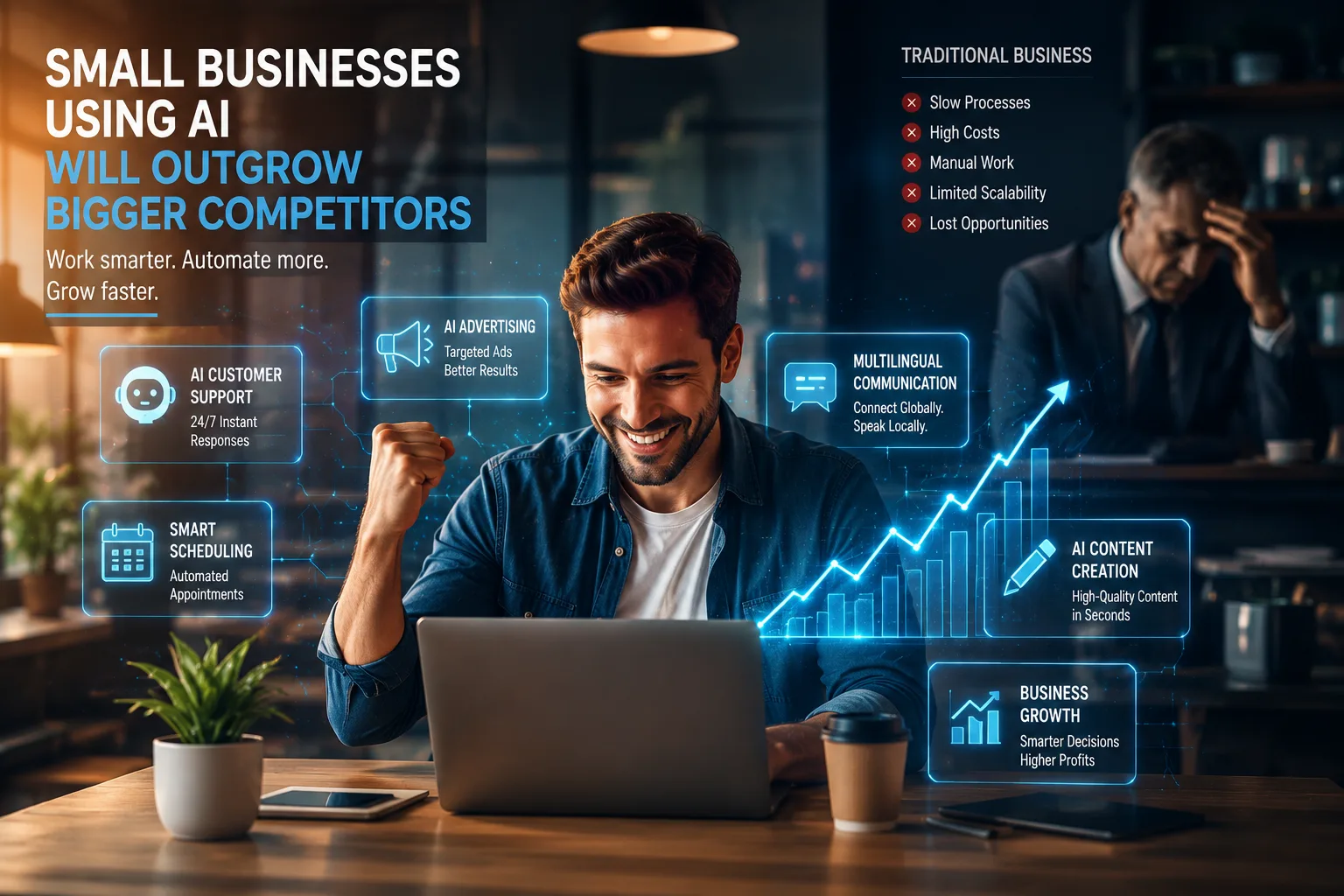
Customer support can be strengthened with conversational AI agents that answer questions instantly, schedule appointments, support multilingual communication, qualify leads, and handle common customer interactions 24 hours a day. For small businesses, that means fewer missed opportunities and a more professional customer experience without hiring a full support department.
Marketing has changed just as dramatically. Campaigns that once required expensive production teams can now be accelerated with AI-powered video generation, voice synthesis, automated editing systems, and intelligent content workflows. Business owners can create social campaigns, promotional videos, voiceovers, branded visuals, and advertising concepts in a fraction of the time and cost previously required.
SEO and digital visibility are more accessible
Website optimization and SEO have also become more accessible through intelligent systems that can analyze performance, identify technical issues, improve visibility, and uncover user experience problems. A small company no longer needs to guess why its site is slow, why visitors leave, or why search engines are not ranking key pages. AI-assisted analysis can surface those problems faster and help teams prioritize what matters.
The playing field is changing because a small business with smart systems can operate with the discipline and efficiency of a much larger company. It can respond faster, publish faster, test faster, and improve faster. That speed matters because digital markets reward businesses that learn quickly and remove friction before competitors do.
This shift is already happening
A local clinic can automate appointment scheduling and customer communication using AI assistants. A restaurant can manage reservations, follow-ups, and customer engagement through automated systems. A real estate agency can use AI-generated advertising campaigns and multilingual messaging to reach broader audiences. An online store can automate support requests, generate product descriptions, improve SEO, and create marketing campaigns rapidly.
A startup can now launch global digital campaigns without building a massive internal team. A service business can answer leads after hours without forcing the owner to stay glued to messages all night. A local brand can produce professional content consistently without waiting weeks for every asset. These changes may seem small individually, but together they reshape what a small business can handle.
Growth is about removing friction
The businesses growing fastest today are not necessarily the ones with the most employees. They are the ones removing friction. They simplify operations, automate repetitive tasks, improve customer experience, respond faster, create content more efficiently, and scale intelligently. AI gives small businesses a practical way to do all of that without becoming bloated or slow.
This matters because time is often the most valuable resource for a small business owner. Many entrepreneurs spend enormous energy handling repetitive administrative work, responding to the same questions manually, creating content constantly, organizing schedules, and managing operational tasks that consume valuable hours every day. AI helps businesses recover that time.
AI should enhance the human side
One of the biggest misconceptions about AI is that it removes the human side of business. In reality, the strongest companies use AI to enhance human capability instead of replacing it. Artificial intelligence can handle repetitive work while humans focus on creativity, strategy, emotion, and relationships. AI can generate ideas quickly while humans shape vision and identity. AI can automate communication while humans build trust and authentic connection.
That distinction is especially important for small businesses, because relationships are often their strongest advantage. Customers choose local companies, specialist teams, and founder-led brands because they feel personal. Technology should support that connection, not flatten it into generic automated noise.
Using AI without strategy creates noise
There is an important warning: using AI alone is not enough. Many businesses are already flooding the internet with low-quality automated content, generic marketing, and robotic customer experiences. Simply using AI tools without direction or strategy creates noise, not value. The businesses that win will combine intelligent automation with authentic branding, strong storytelling, human creativity, and meaningful customer experiences.
People still connect emotionally with people. AI can help a brand move faster, but the brand still needs a clear voice, a useful offer, and a real understanding of the customer. Automation should make the business more responsive and more consistent, not less human.
Lanawi's view on small business AI
At Lanawi, we believe artificial intelligence should help businesses become more efficient, more creative, and more accessible without losing their identity or human presence. The goal is not to automate everything blindly. The goal is to build smarter systems that help businesses grow faster while creating better experiences for customers.
The next generation of successful businesses will not necessarily be the largest companies. They will be the companies that learn faster, adapt faster, communicate better, and use intelligent systems more effectively than their competitors. For small businesses willing to embrace this shift, the opportunity is enormous. In the modern digital world, intelligence and adaptability are becoming more powerful than size alone.
Strong execution comes from turning good principles into repeatable operating habits. That is the difference between interesting advice and durable results.
Discussion
0 comments
Comments are paused while Lanawi upgrades the community experience.