
For years, the public conversation around artificial intelligence was dominated by fear. Social media amplified the panic. Headlines predicted mass unemployment, machines taking over workplaces, and software replacing creativity itself. The story was dramatic, easy to share, and mostly incomplete. What is happening inside real businesses is more practical: AI is not replacing humans. It is replacing inefficiency.
"AI is not the end of human value in business. It is the end of pretending that slow, manual, disconnected systems are good enough."
Writes with a practical operator's lens on ai / automation, blending field experience, implementation detail, and clear decision-making guidance.
The shift is already visible
The fastest-growing companies today are not always the biggest companies, and they are not always the ones with the largest budgets. Many are simply learning how to combine human creativity with intelligent systems. They communicate faster, produce better content, answer customers sooner, and make decisions from clearer data. That advantage compounds because speed changes the entire rhythm of a business.
A small business owner can now create professional advertising concepts with AI-assisted video tools. A clinic can automate appointment scheduling, reminders, and first-line support through conversational agents. A startup can analyze website performance, improve SEO, generate useful content, and personalize customer communication without building a massive internal team. These examples are not science fiction. They are becoming normal operating practice.
AI is replacing delay, not people
The most valuable AI systems do not remove people from the business. They remove the slowest parts of work around them. They reduce repetitive tasks, organize information, generate drafts, answer common questions, and keep workflows moving when human attention is needed elsewhere. That gives owners, managers, designers, marketers, and support teams more room to focus on judgment, creativity, relationships, and growth.
This distinction matters because fear often leads businesses to ask the wrong question. The question is not whether AI will replace the entire human team. The better question is: which parts of the business are consuming human time without requiring human judgment? When that answer becomes clear, automation stops feeling abstract and starts becoming a practical growth tool.
Slow systems are becoming a business risk
Many companies are not struggling because their products are bad. They are struggling because the experience around the product is too slow. Their websites load poorly. Their customer communication is inconsistent. Their online visibility is weak. Their advertising does not match the quality of the offer. Their teams still rely on manual workflows that delay every handoff. Customers rarely diagnose those internal problems. They simply feel friction and move elsewhere.
Modern customers expect fast answers, personalized communication, useful content, and seamless digital experiences. If a competitor responds instantly while your team takes two days, the competitor feels more reliable. If another brand has stronger search visibility, better messaging, and clearer onboarding, customers assume that company is more prepared. In that environment, inefficiency becomes more than an internal inconvenience. It becomes a visible weakness.
Where AI creates immediate leverage
Artificial intelligence can now support businesses in ways that were difficult or expensive only a few years ago. It can answer customer questions instantly, generate multilingual communication, create advertising concepts, support voice conversations, analyze website performance, identify SEO opportunities, draft creative content, organize customer data, automate repetitive tasks, and keep important workflows operating around the clock.
The point is not to add AI everywhere just because the tools exist. The point is to place intelligence where the business is slowest. If leads are waiting too long for a reply, start with customer communication. If marketing output is inconsistent, start with creative production and campaign workflows. If the website is underperforming, start with SEO, content structure, and performance analysis. AI works best when it is attached to a real bottleneck.
Humans still provide the direction
Even with all of these capabilities, AI still lacks the qualities that make a business feel human: vision, emotion, intuition, taste, context, and authentic creativity. AI can generate, but humans give direction. AI can automate, but humans build relationships. AI can process information, but humans understand meaning. A business that forgets this can become faster and still feel empty.
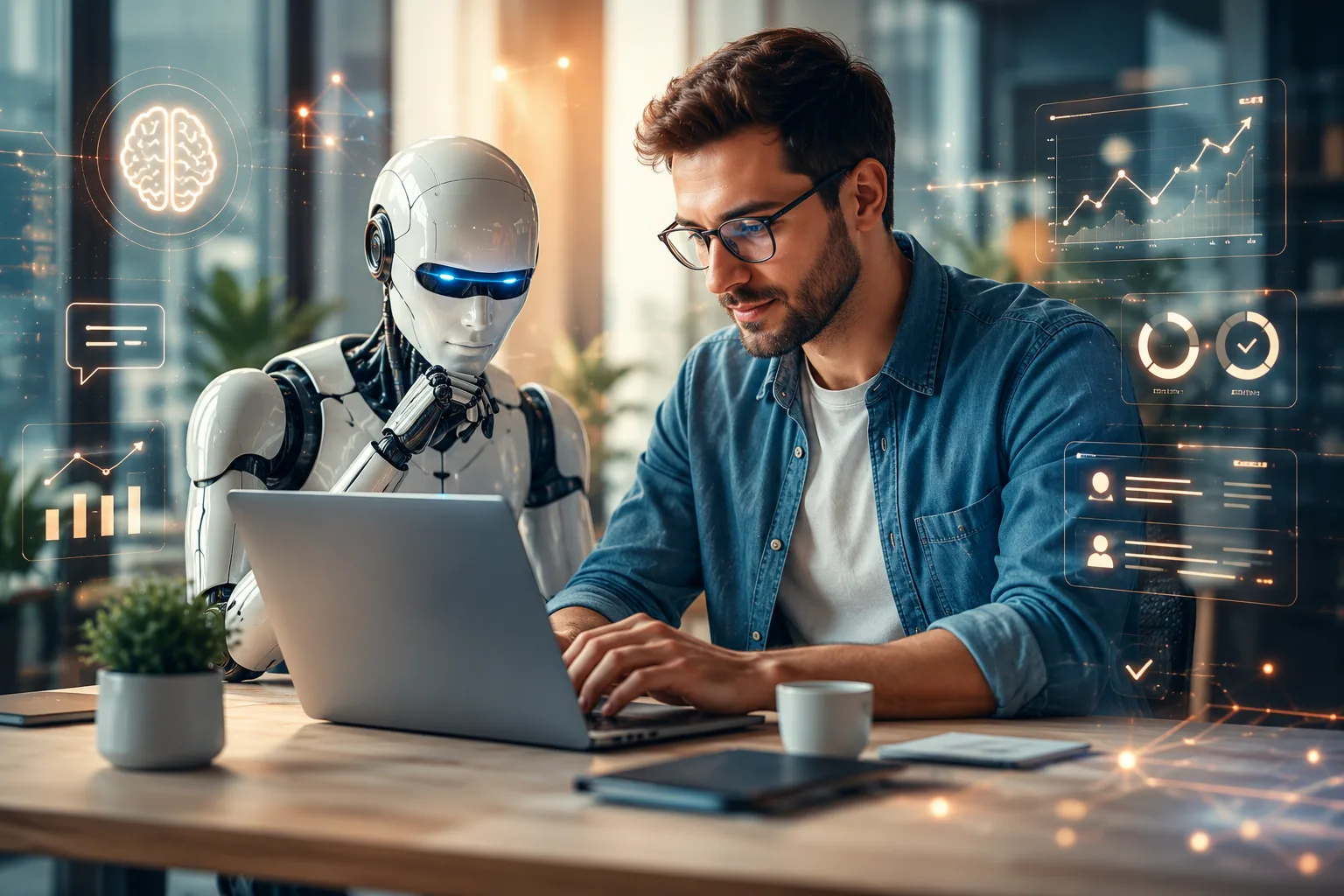
That is why the strongest AI adoption is not blind replacement. It is thoughtful partnership. A good team uses AI to draft faster, then applies human taste. It uses automation to respond sooner, then escalates sensitive conversations to real people. It uses data analysis to find patterns, then relies on leadership to decide what matters. The technology increases capacity, but human judgment gives the work purpose.
The future belongs to adaptive businesses
The companies that benefit most from AI will not be the ones that treat it like magic. They will be the ones that treat it like infrastructure. They will build smarter communication systems, better content operations, stronger customer support, faster creative cycles, and cleaner internal workflows. Over time, those improvements make the business easier to run and easier for customers to trust.
This is where many slow businesses will feel pressure. They may not lose because AI replaced their employees. They may lose because competitors used AI to remove delays, improve visibility, and deliver a better experience. In the modern digital world, speed and adaptability are not luxuries. They are becoming survival requirements.
Lanawi's view on AI and business growth
At Lanawi, we believe AI should empower businesses instead of making them feel disconnected or robotic. Technology should simplify operations, improve communication, strengthen creative output, and create better customer experiences. The goal is not to remove the human side of business. The goal is to give that human side more time, clarity, and reach.
The future is not human versus AI. The future is humans working smarter with AI. Businesses that understand this early will gain a meaningful advantage, not because they chased a trend, but because they built systems that help people do better work faster.
Strong execution comes from turning good principles into repeatable operating habits. That is the difference between interesting advice and durable results.
Discussion
0 comments
Comments are paused while Lanawi upgrades the community experience.